



Organized Retail Crime Prevention: Why Speed Is the Criminal’s Advantage
Organized retail crime prevention is no longer about isolated incidents. Retailers are facing coordinated, calculated operations designed for speed and scale.
Groups study store environments before entering. They understand response limitations, store policies, and how quickly they can move through a space. That awareness changes the dynamic.
Greg Saputo has watched this shift over four decades in retail.
“Organized retail crime was probably not even in its infancy when I started.”
What exists today is a different type of threat.
A Different Type of Theft
In the past, shrink was often categorized as internal theft, external theft, or operational error. Those categories still exist, but they no longer define the full picture.
Organized retail crime operates with coordination. Groups enter together, move quickly, target specific high-value merchandise, and exit within minutes.
The financial impact reflects that shift.
“When an organized group walks in and walks out with 300 purses, it’s $10,000 or $20,000 or $30,000.”
This is not opportunistic behavior. It is structured and repeatable.
Why Speed Changes Everything
Several factors have shifted how these groups operate.
Store teams are trained to prioritize safety. Physical intervention is limited or not allowed. Law enforcement resources are often stretched. In many areas, prosecution thresholds have increased.
Together, these realities reduce immediate consequences and increase reliance on prevention.
“Most retailers just won’t allow their teams to stop people anymore.”
As a result, organized retail crime prevention must focus less on response and more on deterrence.
Why Traditional Approaches Fall Short
Electronic article surveillance has long been a foundation of retail security. Alarms still play a role, but organized groups understand how they work.
They know how long it takes for staff to respond. They know pursuit is unlikely. They know how quickly they can clear a display.
That familiarity reduces the effectiveness of alarm-only strategies.
Greg points to a necessary shift.
“The only deterrent that you have is to transition from electronic forms of protection to mechanical forms of protection.”
The Role of Friction
Mechanical protection introduces something alarms cannot. It introduces time.
Organized groups rely on speed. Their advantage comes from how quickly they can enter, remove product, and exit before any meaningful disruption occurs.
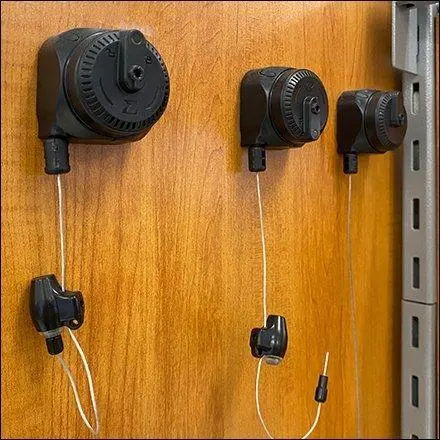
When physical resistance is introduced through secured displays, reinforced fixtures, or tethered products, that speed is interrupted.
Each additional second changes the risk calculation.
“If we can slow them down long enough that the perception becomes that the police have been called… they only have a limited amount of time.”
Organized retail crime prevention is not about eliminating every attempt. It is about reducing volume and increasing hesitation.
Becoming a Harder Target
Greg offers an analogy that reflects the current environment.
“If you’re in a herd of gazelle and every morning a lion is going to chase you, your goal is to run faster than the slowest gazelle.”
Retail operates in a similar way.
Stores that present greater resistance tend to be avoided in favor of easier targets. The objective is not to create an impenetrable environment. It is to create enough friction that risk outweighs reward.
That shift starts with understanding how quickly high-margin products can be removed and where open access creates exposure.
Organized retail crime prevention has become a strategic discipline. It requires adapting to changing behaviors and designing environments that are more difficult to exploit.
While external factors cannot always be controlled, the level of resistance within a store can.
And in today’s environment, that difference determines where attention is directed.
The Next Step
The next step is to evaluate how high-value merchandise is currently protected and where gaps may be allowing for rapid removal.
Connect with the Se-Kure team to explore how to introduce the right level of protection and build a more effective organized retail crime prevention strategy.
Discover more insights on mirror safety, retail theft prevention, security hardware innovation, and display protection strategies on our blog:
https://se-kure.com/blog/
Stay Connected
Follow Se-Kure Controls: