


Retail Theft Prevention Solutions Start With the Right Problem
Retail theft prevention solutions are not simply about adding more locks, alarms, or barriers. The better starting point is understanding exactly what needs to be protected, how customers need to interact with it, and what success should look like once a solution is in place.
That problem-solving mindset is something Bill Zuckerman, VP of Product and Innovation at Se-Kure Controls, brings from a career spanning engineering, manufacturing, and product marketing. As he explained during a recent SME discussion, much of product development comes down to “taking the complexity and trying to make it more human.”
For retailers, that starts with asking better questions.
Start With the Actual Use Case
There can be many ways to secure merchandise, but not every solution makes sense for every environment.
A retailer protecting a phone display has different requirements than one protecting handbags, apparel, or merchandise on a shelf. Before choosing between mechanical security, an alarm, a recoiler, or another display security product, the actual use case should be defined.
How does the customer need to interact with the merchandise? What does an associate need to do during a sale? How much movement should the product have? What type of theft is the store trying to deter?
As Bill put it, “There’s a million ways to solve a problem,” but understanding the primary use case helps narrow those choices into something practical.
Find the Balance Between Security and Access
One of the biggest challenges with retail theft prevention solutions is that protection and accessibility can pull in opposite directions.
A product can be secured so tightly that theft becomes more difficult, but legitimate customers may also find it harder to shop. On the other hand, completely unrestricted access can expose merchandise to unnecessary risk.
“You don’t want to impede sales, but you want to impede the theft.”
That balance should guide the security decision.
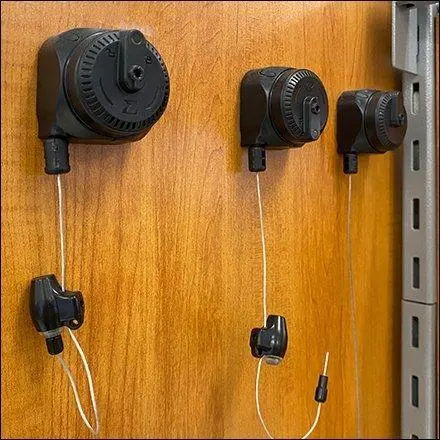
Se-Kure offers mechanical security products, electronic alarms, recoilers, and display security systems that give retailers different ways to approach that challenge. The objective should not automatically be maximum restriction. It should be the appropriate amount of protection for the merchandise, environment, and customer experience.
Decide What Success Looks Like
Before installing new retail theft prevention solutions, retailers should also determine how they will judge whether those solutions are working.
“We should all be kind of driven by success measurements.”
Reducing theft is an obvious measurement, but it is not the only consideration. Did the solution make daily operations more difficult? Can associates still access merchandise efficiently? Are customers still able to interact with products as intended?
Looking at both security and usability provides a more complete picture.
A solution that reduces one problem while creating another may need to be reconsidered.
Do You Actually Need a Custom Solution?
Customization can be valuable, particularly when a store has a unique fixture, merchandise requirement, finish, cable length, or installation challenge. Se-Kure’s manufacturing capabilities allow products to be adapted when the application genuinely calls for it.
Still, different does not automatically mean better.
“We’ve tested this. We know it works.”
A proven standard solution may already accomplish what the retailer needs without introducing additional cost or complexity. Changes should have a purpose and solve a meaningful problem rather than simply make a product different.
That leads to one of the most memorable ideas from the conversation:
“I don’t make a million-dollar mousetrap to catch a mouse.”
Keep the Solution Focused on the Problem
The best retail theft prevention solutions do not necessarily have the most features or the newest technology.
They solve the problem in front of them.
Start with the use case. Understand how customers and employees need to interact with the merchandise. Identify the acceptable trade-offs. Establish how success will be measured. Then determine whether an existing solution works or whether something more specialized is actually necessary.
Retail security becomes much easier to evaluate when the conversation starts with the problem instead of the product.
Stay Connected
Choosing the right retail theft prevention solutions starts with understanding your merchandise, your store layout, and your customer experience. With the right mix of display security and customer assistance tools, stores can protect products while keeping shopping simple.
Discover more insights on retail theft prevention, security hardware innovation, and display protection strategies on the Se-Kure Controls blog:
https://se-kure.com/blog/
Follow Se-Kure Controls
Follow Se-Kure Controls for industry updates, product innovations, and expert perspectives: